
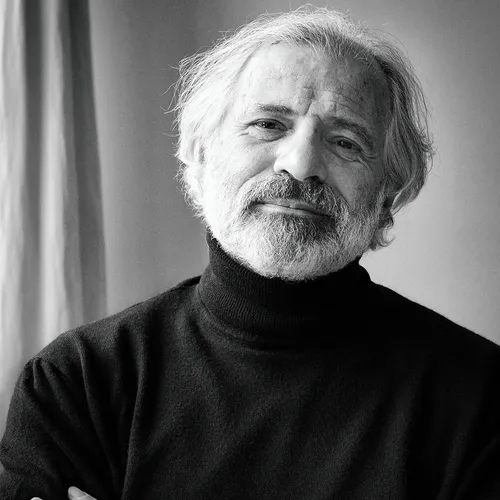
Born in Buenos Aires (Argentina) in 1953, Italian conductor and composer Emilio Pomarico is widely recognized as one of today’s foremost interpreters of contemporary music. A tireless champion of emerging composers, he has devoted his career to supporting new musical voices, through premieres and mentorship, while forging lasting collaborations with some of the most influential composers of our time, including Georges Aperghis, Karola Bauckholt, Luciano Berio, Pierluigi Billone, Unsuk Chin, Brian Ferneyhough, Georg Friedrich Haas, Helmut Lahenmann, Luigi Nono, Emmanuel Nunes, Younghi Pagh-Paan, Wolfgang Rihm, Kaija Saariaho, Rebecca Saunders, Salvatore Sciarrino, Hans Zender, Agata Zubel, among others.
Pomarico has conducted numerous landmark premieres, including Emmanuel Nunes’ Quodlibet, Rihm’s Seraphin Symphonie, Haas’ Melancholia at the Opéra Garnier, Ferneyhough’s entire cycle of Carceri d'Invenzione, and Finis Terrae at the Opéra Bastille, Hans Zender’s Logos Fragmente at the Berlin Philharmonie.
His long-standing partnership with Georges Aperghis has resulted in major creations such as Situations, Études pour Orchestre, Accordion Concerto, and Migrants, presented across Europe between 2013 and 2025.
Equally active in opera, Pomarico has led acclaimed productions including H.Lachenmann’s Das Mädchen mit den Schwefelhölzern (Ruhrtriennale), M.Feldman’s Neither, S.Sciarrino’s Luci mie traditrici(Wiener Festwochen), P.Boesmans’ Pinocchio (Festival d’Aix-en-Provence), F.Filidei’s L’Inondation (Opéra Comique), B.Lang’s Playing Trump (Hamburg State Opera), and P.Boesmans’ Julie (Opéra deDijon). He has collaborated with renowned stage directors including Robert Wilson, Romeo Castellucci, Silvia Costa, Joël Pommerat, Sandrine Anglade, Achim Freyer, and Philippe Quesne.
Pomarico served as Conductor in Residence with Ensemble Resonanz in Hamburg, inaugurating the Elbphilharmonie’s Kleiner Saal in January 2017 with Haas’ Release. He regularly performs with major European Radio Orchestras and leading contemporary ensembles such as Klangforum Wien, Ensemble Musikfabrik, and Collegium Novum Zürich, Contrechamps.
Recent highlights include performances with the Tokyo Symphony Orchestra at Suntory Hall, where he isalready invited again in 2027, and upcoming engagements with the Slovenian Symphony Orchestra in Ljubljana, Ensemble Contrechamps in Geneva, Klangforum Wien in Salzburg and Vienna, Ensemble Intercontemporain in Paris, Spanish National Youth Orchestra in Madrid, Lisbon Metropolitan Orchestra.
As a composer, his music has been performed in Contemporary Music Festivals such as, among others, Contrechamps in Geneva, Musica nel Nostro Tempo in Milan, Musik der Zeit Koeln, Wittener Tage fürNeue Kammermusik, Wien Modern, Festival d'Automne and Presence in Paris. A CD of his Trios performed by the ensemble recherche has been published by the label Zeitklang in 2014.
In March 2024, at the Wiener Konzerthaus he premiered his most recent composition, Concerto for 24 Instruments [Paralipomena a Caractéres di N.Castiglioni] (2023), commissioned by Klangforum Wien.
His recordings are available on Kairos, Neos, Wergo, ECM, AEOM, and Col Legno, and a CD of his own compositions is published by Zeitklang.
The inspiration for the composition of my Konzert stemmed from an invitation by Klangforum Wien's then Managing Director, Sven Hartberger, to compose a piece that would relate to Niccolò Castiglioni’s music.
I enthusiastically embarked on this project despite the challenges of balancing composition with my conducting duties, which unfortunatelyended up delaying it by well over a decade. Despite the deep sense of uncertainty and gloom engulfing us all at the time, the unexpected halt in my concert activities due to the COVID pandemic became for me a catalyst for creativity, allowing me to complete the Konzert by 2023.
I prefer to eschew any attempt to verbally describes the music of this piece, which, in my opinion, may become redundant and fail to addmuch to its understanding.
For the listener’s curiosity, however, it may be interesting to mention that, to form the foundation of Konzert, I focused nothing more than to a small fragment, a sequence of 15 pitches taken from Castiglioni’s Caractères, an orchestral piece he composed in his youth, precisely in 1964—extracted directly from the beginning of the piece.
I let this musical seed grow, branch out and blossom into a full-fledged composition, featuring reflections, arguments and digressions, followed by sequences of contrasting, if not quarrelling, inventions.
All of the compositional modalities adopted in this piece are guided by the exercise in style aesthetic principle. Should one wish to look for rationale in my personal intent, it may sound like nothing other than an attempt to answer the following question: is it still possible to say something new, and perhaps necessary, using stylistic clichés that have possibly already become history in our musical culture?