
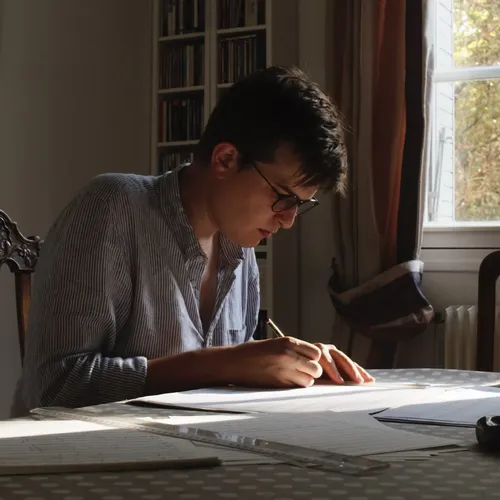
Alexandre JAMAR is a Belgian composer, born in Paris, in 1995. His approach to composition is shaped by his career as a singer trained in early music. His particular interest in the connections between literature and music is refected in the prominent place vocal music occupies in his catalogue. He is also fascinated by the expressive possibilities of purely instrumental music, in line with Baroque theories of the affects. His interest in the music of the past is also evident in his transcriptions, which he regards as a compositional practice in their own right.
His music has been performed by ensembles such as the Ensemble l’Itinéraire, the Ensemble Intercontemporain, the Ensemble Cairn, the Orchestre de Picardie and the Ensemble Ecoute. He is in residence with the latter from 2022 to 2025, and takes part in many of the ensemble’s concerts and educational workshops. In July 2022, he won the frst edition of the Elan competition, organised by IRCAM and the Orchestre national d’Île-de-France, for his piece Five Forest Studies. In August 2026, he took part in the Lucerne Festival’s composition academy, mentored by Unsuk Chin and Dieter Ammann. He will be resident at the Akademie der Künste in Berlin from October to December 2026.
Alexandre Jamar studied composition from 2020 to 2025 at the Paris Conservatoire (CNSM) under Gérard Pesson, and subsequently at the Musikhochschule in Freiburg im Breisgau under Johannes Schöllhorn. He studied Baroque singing with Caroline Bardot, Jérôme Corréas and Stéphane Fuget at the CRR in Paris, and performs as a singer with ensembles such as accentus (cond. Laurence Equilbey), Les Métaboles (cond. Léo Warynski) and Les Cris de Paris (cond. Geoffroy Jourdain). He also holds a degree in cultural administration from Sciences Po Paris, which he completed in 2018.
alfabet takes its inspiration from a collection by the Danish poet Inger Christensen, published in 1981. Through a dizzying art of enumeration, she celebrates everything that exists on Earth, with the aim of ensuring its survival through the written word, speech and memory. The text is organised according to two simple principles: the alphabet and the Fibonacci sequence. The enumeration of things that ‘exist’ follows alphabetical order, and the number of lines increases with each poem according to the Fibonacci sequence (1, 2, 3, 5, 8, 13, etc.).
I have retained these two principles in the music, the instrumentation of which grows as the piece progresses, and whose vocal parts consist of words corresponding to this alphabetical logic. The electronic part is a complete reading of the first ten poems in the collection by María Cristina Kiehr. Capturing the recitation on a recording allowed me to compose with greater precision and to seek for closer correspondences between text and music. For me, the appeal of this collection lies in the fine line between constraint and clarity along which it unfolds. Christensen succeeds in combining her formal approach to writing with intense lyricism and a dazzling immediacy of expression.