
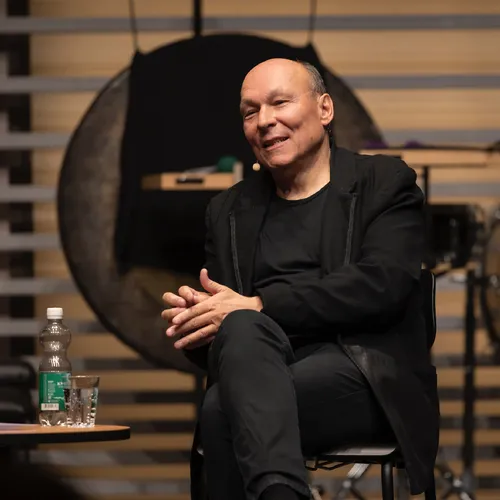
Dieter AMMANN was born in Aarau (Switzerland) in 1962. He grew up in a very musical family. After graduating from high school, he studied school music/conducting (Lucerne) and at the same time completed a course at the Swiss Jazz School in Bern. The 1980s and early 90s were characterized by Europe-wide concert activities and recordings in the field of jazz/improvised music, with artists as diverse as Eddie Harris (CD Yeah, you right) and Udo Lindenberg.
This was followed by studies in theory/composition at the Basel Music Academy (Roland Moser, Detlev Müller-Siemens) with courses with Witold Lutoslawski, Wolfgang Rihm, Dieter Schnebel and Niccolo Castiglioni.
At the age of 30, he turned to composition. Due to his scrupulous and slow approach to his work, a commissioned work can take two years or more to complete. He has received numerous national and international awards for his chamber music and orchestral works, including grants from the Aargau Board of Trustees, the Canton of Lucerne, the Franz Liszt Scholarship from the “Weimar European Capital of Culture” Foundation, the main prize from the IBLA Foundation New York (in honor of L.Berio) and the “Young composers in Europe” competition (Leipzig), the Ernst von Siemens Prize forComposition, the Swiss Music Prize and the AZ Media Prize for Culture. In 2026, he was honored with the OPUS KLASSIK award as “Composer of the Year,” with “glut – music for orchestra”.
He is also a much sought-after lecturer, for example, together with Wolfgang Rihm or Unsuk Chin, at the Composer Seminar of the Lucerne Festival Academy or the Impuls Academy Graz. He leads a composition class at the Lucerne University of the Arts and has lectured at the Bern University of the Arts.
Ammann has received invitations as composer-in-residence to festivals such as the Davos Festival, Les Muséiques Festival, the Lucerne Festival, Wittener Tage für neue Kammermusik, Sommerliche Musiktage Hitzacker, the ReMusica Festival St. Petersburg, Tongyeong International Music Festival and the Weywuying Festival. In addition to the renowned Swiss orchestras (Tonhalle, Philharmonia Zurich, Lucerne, Basel, Bern, Suisse Romande), his works have been performed by orchestras such as the Boston Symphony Orchestra, BBC Symphony Orchestra, Philharmonia London, Helsinki Philharmonic, Mariinsky Symphony, Munich Philharmonic, Vienna Symphony Orchestra, Munich Chamber Orchestra, DSO Berlin, WDR, Lucerne Festival Contemporary Orchestra, Klangforum Wien, Ensemble Modern Orchestra, Ensemble intercontemporain, Quatuor Diotima, Mondrian Ensemble, ensemble recherche, conducted by Pierre Boulez, George Benjamin, Jonathan Nott, Baldur Brönnimann, Sylvain Cambreling, James Gaffigan, Valery Gergiev, Pablo Heras-Casado, Susanna Mälkki, Sakari Oramo, Matthias Pintscher, Emilio Pomarico, David Robertson, Peter Rundel, Michael Sanderling, Markus Stenz, Mario Venzago and many others. Artists such as Carolin Widmann, Andreas Haefliger, Michael Barenboim, Tabea Zimmermann, Nils Mönkemeyer, and Maximilian Hornung interpret his solo pieces and concertos.
Ammann’s works are published by Bärenreiter Verlag and Swiss Music Edition SME/musinfo.ch.
After his Violin and Piano Concertos Dieter Ammann has turned his attention to the viola and its soloistic possibilities. Two things are striking: undisguised tonality and political influences.
With some breaks, Dieter Ammann has been working for four years on a new concerto. After the Violin Concerto “unbalanced instability” (2012/13) and the Piano Concerto “Gran Toccata” (2016–19) Ammann has devoted himself to a commission for viola from the Sinfonieorchester Basel, Munich Chamber Orchestra, Lucerne Festival, Tongyeong Music Festival and Esprit Orchestra Toronto. It is the deep tessitura of the instrument’s lowest string which attracted him, “because this has the range which I didn’t have in my Violin Concerto, and I love hearing the viola at the bottom of its range”. The concerto begins with an ironic examination of the genre: the instrument is intended to “imitate the process of tuning up”, according to the performance instructions in the first bar of the solo part. First of all the open C string is heard, but a minor second too high, followed by a fifth. Finally, after a diminished fifth, two further perfect fifths are heard above this. It is not only the two lowest strings of the instrument which appear to be “out of tune”, but the instrument also has an additional “imaginary” fifth string. But this “joke” at the beginning is the only jolly thing about the work. What starts out as fun soon becomes serious, and a “struggle” between solo instrument and orchestra begins: “The viola has to make its voice heard as an individual pitted against the tutti” (Ammann). The confrontation of the individual and the collective, the different degrees of “convergence and divergence” are themes explored by the composer in all his concertante works.
After the opening, with its frequent pauses, events intensify and the music reaches a high level of density. The fifth at the beginning is now the structurally important interval; it appears both melodically in the horizontal, but also harmonically in the vertical – here certainly ‘tonal’. In his questfor beauty, in this work the composer completes a further step towards undisguised tonality.“Undisguised, but not unthinking”, as Ammann explains, “for these zones of tonality are exposed on the one hand to various states of (in)stability and in addition, are confronted by completely different tonal atmospheres”.
Dieter Ammann is a highly political human being. The “change of order”, perceived and taking place on various levels, leads to the fact that “in its process of taking shape” his music will “also be contaminated by external events beyond itself”. The sound becomes the story, without this necessarily being understood through hearing, for his music is “not the means, but the purpose. The sound is not a vehicle for any kind of information transfer. It IS the information. It does not speak of itself, but from itself, indeed ‘for itself’ in the literal sense of the word.” Furthermore, for the first time there is the processing of a personal loss, the death of a close friend and colleague, reflected in sound textures. This “lament abounding in quotes” (Ammann) is largely left to the solo instrument.
It was in fact the Piano Concerto which was to be entitled “no templates”, which primarily meant “an openness of thought in the approach to this genre”, but also “an openness in relation to the variety of means used”. Now Ammann has given this title to his Viola Concerto. His music, says the composer, “combines a great variety of different textures”. In the course of a piece, everything can happen at any point in time. The sole constant is the continuous transformation “from a flowing transition to the point of rupture”. Thus the music finds itself in constant communication outwards, but at thesame time also inwards, by examining itself, and from time to time even questioning itself.” The result, in this concerto too, is always exciting music “dramaturgically strongly portrayed in detail”, but above all a music which speaks, which communicates with and carries the audience.
Robert Krampe
(translation: Elizabeth Robinson / from [t]akte 2/2024)
The long genesis of the piano concerto is tightly connected to the soloist, Andreas Haefliger. When we first met years ago we instantly realized that our chemistry was right. One day Andreas suggested that I should write a piano concerto for him. This proposal did not delight me in the beginning since I knew that it would take me not only months but years to work on this piece. This premonition was based on two reasons. My scrupulous, perfectionist way of working is mainly responsible for the fact that even the creation of a chamber music piece can take up to two years. The resulting music is densely woven, highly energetic, and very often accompanied by high tempos.
I was fully aware that the working duration of a concerto for piano, which itself is a small orchestra, and large orchestra would be protracted further. When I began my work on glut, a piece for orchestra, in 2014, I seemed to have subconsciously accepted Andreas's challenge already because I decided to integrate the piano as an orchestral instrument. These experiences were a further important step toward the piano concerto, which I started working on in the end of 2016.
The piece starts with a solitary, pulsing single tone which rapidly causes reactions by the orchestra. lt is obvious that the orchestra is not just a mere passive accompaniment, but it rather meets the soloist at eye level. The interplay between the two congenial partners creates a dramaturgically gripping progression with many surprising twists and turns. As a listener l like to be thrown into a variety of different musical conditions and to be thrilled by the music. As a composer, I condense every "tonal vision" with the result that they can potentially become carriers of high energy. This high level of density within the piano's and the orchestra's parts and furthermore the close interlocking of the two parties require great virtuosity of all participants. During the musical drama the soloist can even be swallowed by the orchestra and might be turned into a cog in the big "orchestra machine." The piano enters various partnerships with varying instrumental groups, for example when the piano merges with marimba and vibraphone to form a single instrument.
Due to its driving behavior the piano sometimes turns into some type of percussion and shows its rhythmic virtuosity through percussive figures (hence the subtitle). At times the music also comes to a rest and draws breath in static or inwardly iridescent moments, just to continue its path with new strength. The harmony also offers a wide range, in which the orchestra can unfold its full colorfulness. There are bright, consonant chords, but also hard sound clusters up to noisy sounds, whereby the tempered tuning meets microtonality.
Towards the end of the musical journey the soloist, in a moment of inner contemplation, cites a quiet, chorale-like theme from my very first composition.
But-as always in arts-the effect and the piece's message lie between the notes and beyond words. The listeners are invited to discover these for themselves in a very personal, subjective way. Although the major part of the concerto was written during night sessions and sometimes until the morning dawned, the result is bright music, dedicated to people with an alert mind.
Dieter Ammann