
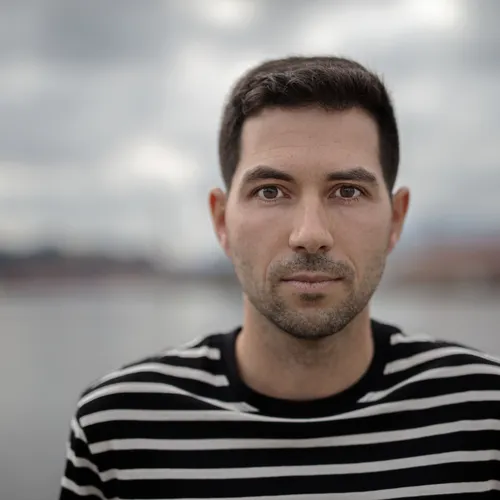
Mikel URQUIZA (1988, Bilbao-Spain) writes lively, colourful music, where things are not what they seem : every idea hides another one, peripheral elements become central, and what looks serious pulls a face. Extroverted and original, his voice has found its place among orchestras such as Orchestre Philharmonique de Radio France or the WDR orchestra. In 2026, he writes for the Spanish National Orchestra (cond. Kent Nagano) and the Kansas City Symphony (cond. Matthias Pintscher).
In 2022 he received the Composer prize of the Siemens Musikstiftung and in 2023 the Georges Enesco prize of the SACEM. In 2023-2024, he was the guest composer of Divertimento ensemble, the Meridian Festival in Bucharest, and the Tampere Biennale. In 2025-2026 he is composer in residence at the festival Musiques démesurées in Clermont-Ferrand.
A choir singer all along his youth, he is passionate about voice and shows it in Alfabet, written for Sarah Maria Sun, I nalt be clode on the frolt, for Marion Tassou, Songs of Spam, for the Neue Vocalsolisten, and Howl, premiered by the vocal ensemble Exaudi at the Wittener Tage für neue Kammermusik 2022. In 2021, Ryoko Aoki premiers Chiisana tsubame at the Suntory Hall in Tokyo.
He collaborates regularly with the ensemble Intercontemporain, L'Instant Donné and C Barré, and has worked with Klangforum, Musikfabrik, Mosaik, Divertimento, and the New European Ensemble at festivals such as Présences, ManiFeste, ECLAT, Acht Brücken, Gaudeamus, in Lucerne, and at the Venice Biennale.
His chamber music pieces, full of imitative writing, bizarre associations, and all sort of tricks, are premiered by first-class partners such as Kebyart Ensemble, which performed Les perfectibilités at Palau de la Musica in Barcelona or Quatuor Diotima, which premiered his first string quartet Indicio at the Festival Pontino in Italy, and the second string quartet Index at the Festival Musica in Strasburg. The Trio Catch premiered Pièges de neige in 2018, then a triple concerto in 2025 : bearing the title "Un désir démesuré d'amitié", it attemps to bring the feeling of chamber music making to the orchestral sound.
Mikel Urquiza studied composition first at Musikene (San Sebastian) with Gabriel Erkoreka and Ramon Lazkano, then at Paris CNSM with Gérard Pesson and Stefano Gervasoni. In 2019-2020 he was first mentored by the Peter Eötvös Contemporary Music Foundation, then a fellow of the French Academy in Rome - Villa Medici. His PhD thesis, written within the SACRe programme and tutored by Laurent Feneyrou, is intitled "Music regained: memory at work in musical composition".
His two monographic CDs, Cherche titre (featuring L'Instant Donné and Marion Tassou) and Espiègle (featuring C Barré and the Neue Vocalsolisten), have been enthusiastically praised by the critic and broadcast by the main radios in Europe.
The title of my new triple concerto, which translates as An unbounded desire for friendship, seems premonitory, now that freedoms are cut in many countries (in the United States, of course, but also in Italy and Hungary, two countries that I love). In Dutch (the original), the title is a verse of a poem by Jacob Israël de Haan, engraved on the Homomonument in Amsterdam (which commemorates gays and lesbians killed by the Nazi regime). In French, it's the title of a book by Hélène Giannecchini, which focuses on the strong links that queer people establish in order to survive in a society that is built around families. In music, it's something else.
Writing for a trio of soloists, and specifically for a trio of friends, has made me reflect about the nature of musical friendship. If a concerto is normally forced to tackle the relation between the individual and the group, here I had the chance to explore intermediate nuances of opposition and integration, creating a rich palette of colours and relations. Essentially, I don't take the trio for granted: each of the three instruments is both a soloist (an individual with its own family in the orchestra) and a member of the chamber group, to which it belongs through affinity, affection, kinship, friendship.
The first movement, "Q", explores the notion of queerness (at a time where many countries are trying to erase it), an individual expression which disregards a shared aesthetics : I have built an open space where many referential models coexist in disorder, encouraging bizarre solutions, excessive materials and sexy rhythms ("q", read as "cul", is slang for sex in French). The second movement, "Le seul visage", is an homage to the photographer and writer Hervé Guibert [...]. The third movement, "Dévier, défier", is shaped by the acoustics of a protest, finding in the open air euphoria a subject for musical speculation – lively, yet powerful. [...]