
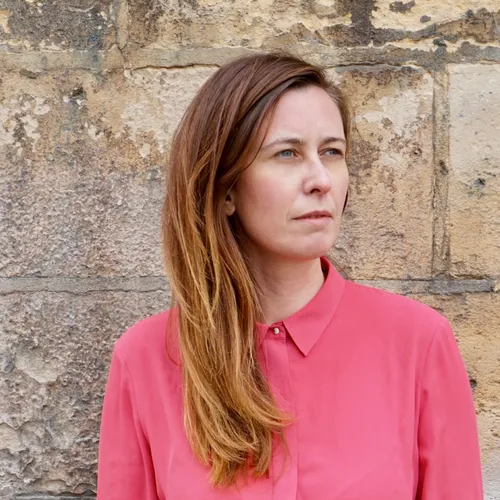
Claudia Jane SCROCCARO (1984, Italy) is a composer based in Paris, where she teaches electronic music at IRCAM.
Her work explores the interaction between instrumental writing, voice, and digital technologies, with a focus on formal structures, spatialization, and the social dimension of listening. Her practice often draws on literary, visual, and documentary sources, exploring how extra-musical materials can shape musical form and modes of listening.
After initial training in piano and orchestral conducting, with Piero Bellugi, she studied musicology at the University of Rome Tor Vergata before pursuing composition and electronic music at the Santa Cecilia Conservatory. Supported by a DAAD scholarship, she continued her composition studies with Marco Stroppa at the Stuttgart University of Music and Performing Arts, and later joined IRCAM’s Cursus in Composition and Computer Music, where she has taught since 2021.
She was a Fellow of the French Academy in Rome – Villa Medici in 2024–2025, where she developed a research project around the Franco-Italian poet Amelia Rosselli, exploring the musical portrait as a space for memory, identity and representation across music, literature and the visual arts.
Her music has been presented at major European festivals, including Donaueschinger Musiktage, IRCAM ManiFeste, Festival ECLAT, Festival Propagations, Ultima Oslo and Warsaw Autumn, with the support of IRCAM, Fondation Royaumont, France Musique, SWR, and the Fondation Pierre Boulez. It has been performed by Ensemble Musikfabrik, SWR Vokalensemble, Johanna Vargas, Carolina Santiago, Talea Ensemble, Ensemble Linea, and Florentin Ginot.
Recent projects include On the Edge (SWR Vokalensemble, SWR Experimentalstudio, Donaueschinger Musiktage), FARO (Ensemble Musikfabrik, Fondation Pierre Boulez, Villa Medici, IRCAM), and Espaces Blancs (GMEM Marseille).
Her sound installation Détails et retailles, conceived as a dialogue with Henri Matisse’s Jazz, was recently presented at the Grand Palais of Paris as part of the exhibition Matisse 1941–1954, produced by the Centre Pompidou and IRCAM.
On the Edge explores the boundaries between virtual and physical spaces, imagined and embodied voices, individual and collective perception.
The audience is drawn into a sonic world inspired by the experiences of women living at the margins of society, voices that carry within them a multitude of forms, spaces, and faces, like a perpetually shifting polyhedron. At the heart of the work lies a question directed at all of us: whose version of reality do we accept, and how can we reawaken our capacity to hear voices that have long gone unheard?
The piece grew out of workshops with women living in shelters in the Paris area, rebuilding their lives after experiences of trauma and displacement. Rather than addressing these experiences directly, we worked with musical memories, lullabies, songs and fragments of melodies, as an indirect way of approaching memory and creating a shared space. These memories entered into dialogue with the early poetry of Mina Loy, whose fragmented language and nomadic existence offered a poetic space in which the material gathered during the workshops could resonate and be transformed.
The spatial and technological conception is inseparable from its musical form. The work begins while the audience is still gathered in the foyer and the concert hall remains empty. Yet the two spaces are already acoustically connected: hidden among the audience, the soloists carry the sound of the choir through loudspeakers worn on their bodies, while their own live voices are simultaneously transmitted into the hall. Physical and virtual presence begin to overlap.
The soloists’ singing gradually emerges from the noise of conversation, as the surrounding chatter gives way to listening. One of the singers eventually leads the audience towards the concert hall, where they discover the choir already singing in the empty auditorium: a sonic space that existed before their arrival and whose voices had already reached them from elsewhere.
The work begins with an empty auditorium and ends with an empty stage, as choir and soloists gradually leave the hall singing until the music disappears, tracing an arc from noise into listening, and from music into silence and making the audience’s own act of listening part of the composition.
On the Edge was developed with the SWR Vokalensemble, the conductor Yuval Weinberg and the SWR Experimentalstudio, and commissioned by the Donaueschinger Musiktage.