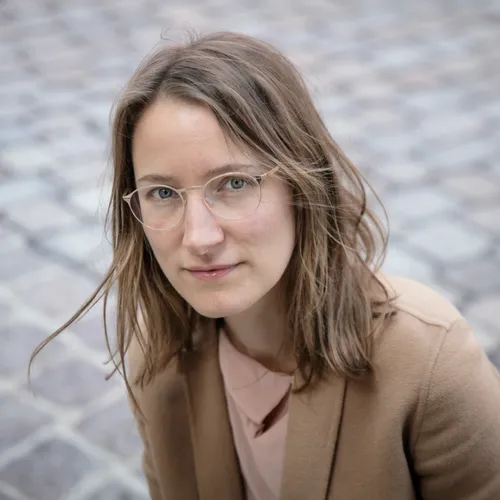
In the music of Catherine Lamb (b. 1982, Olympia, Washington USA), the mathematics of harmony are explored through the physicality of the material world. Lamb gives voice to crystalline structures of the harmonic series through subtleties of friction, pressure, breath, and bow changes that shape how the idealized harmonies speak. The musical forms she constructs connect the sonic with the tactile and the visual, rendering transparent what once was opaque, transmuting flesh to bone, passing from shadow into light. These dualities and metaphors reflect Lamb’s deep interest in the fundamental nature of sound and often find themselves in the titles of her pieces: shade/gradient (2012), point/wave (2015), interius/exterius (2022).
Lamb’s approach to tuning and pacing are informed by her studies with microtonal composer James Tenney and experimental filmmaker and Dhrupad musician Mani Kaul at the California Institute of the Arts.
Like her mentors, Lamb has been a champion of the music of others, an ardent collaborator, and a key figure in various vibrant musical communities.
While living in Los Angeles, Lamb co-founded “singing by numbers”, a women’s choir that aimed to create new pedagogical approaches to microtonal singing with vocalists from a wide range of musical backgrounds. The convergence of musical explorations with feminist practices is also found in her collaboration with violinist and violist Johnny Chang, in which they “recover and interpret” the long-forgotten music of a fictitious female musician, Viola Torros. In doing so, they question and blur the origins of early European music and call attention to the exclusion of real female musicians in the historical record.
Lamb is one of the most celebrated and in-demand composers of her generation. Her work has been commissioned by premiere new music ensembles such as the JACK Quartet, Yarn/Wire, Dedalus, and Ensemble Musikfabrik.
Her writings and recordings are published in KunstMusik, Open Space Magazine, New World Records, Another Timbre, Other Minds, Sound American, and Sacred Realism.
In 2016 to 2017, she was an artist-in-residence at the Akademie Schloss Solitude in Stuttgart, Germany.
In 2018, she was given a Foundation for Contemporary Arts Grants to Artists. In 2020, she was awarded the prestigious Ernst von Siemens Composer’s Prize.
She currently resides in Berlin where she contributes to many new- music initiatives including the experimental music label Sacred Realism and the Harmonic Space Orchestra.
Text written by friends Laura Steenberge and Michael Winter, summer 2023
This piece searches for the in-between spaces where opposing elements corrade together, as in form/formlessness, cycle/change, sound/language, story/poetry, return/ evolve, destruction/empathy, pattern/dissolution.
It takes direct inspiration from the work of the author Ursula K. Le Guin, drawing in particular on her 1985 masterpiece Always Coming Home. In our increasingly hostile world corrupted by fascism and greed, Le Guin’s imbued Taoist philosophies center on the visualisation of tangible pathways towards more peaceful realities, allowing for a shimmering refuge for her readers.
Returning to the Tao Te Ching, believed to be written by Laozi in the late 4th century, it is stunning to experience the direct relatability to our current world. The same problems, the same kinds of human difficulties. I imagine an infinite cycle where on each return new and more perceptions keep emerging; new technologies, more people, more complexities, more feelings – the same problems, just magnified. Evolving and returning at the same instance. She plays with this while imaging realities far into the future – different but relatable, more expanded. So, I ruminate on a poem of hers entitled From the People of the Houses of Earth in the Valley to the Other People Who Were on Earth Before Them, written in the 1980s, from the perspective of a peacefully evolved, futuristic utopian community in northern California, while at the same time passing on ancient knowledge from some original dwellers (such as the Yurok and the Papago). The poem is a message from one potential future reality addressing our own current reality as well as past realities (whether Le Guin’s perspective in the 1980s or Laozi’s perspective in the 4th century BC). It is at the heart of this piece, the title of which was inspired by a line in the poem.
My work has typically rejected the use of vocalized language – as I find that the state of listening involving language acquisition occupies a very different phenomenological state than listening to sound without direct linguistic meaning. However, songs are one of the earliest human art forms that have continued to thrive and will certainly continue further. They have the incredible ability, perhaps more than any other art form, to reflect on the human experience, like love and resistance. In Le Guin’s imagined realities, songs are extremely important, elemental, and assumed. Like the story.
It’s Le Guin’s particular classical storytelling, her experimentalism, her blurring of time/space, and her deep love of humanity – in spite of it all – that continue to draw me back to her writing. For her, I allow actual words into the music, her words.
23.11. dying your dying to come closer 299
So I made a song, and that’s where the actual work began. Caring for the words and seeing what emerges from that state. Shining a light on them during a state of darkness, and out of darkness.
Story, song, music, melody, time, harmony, relation, perception. I want to offer a space that is cyclical yet evolves as it touches the words. New forces and elements enter, and things change again and again, so that we experience the return through the potentiality of its directional planes, leading us, simply, towards something better. Therefore, I structured the piece to have various recognisable parts and patterns, which return, but with new information and experiences each time – new colorations, new combinations, new states of emptiness and density, new motion. And in the right circumstance, it is constructed to be able to connect the end to the beginning and continue onwards. It is Ancient Music – nothing new, everything new.
Catherine Lamb