
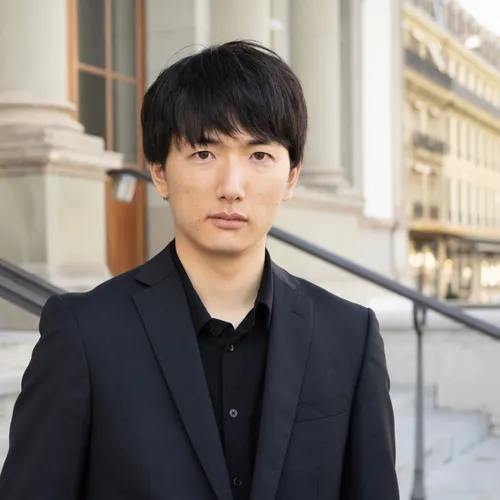
Born in Japan in 1995, Yuki NAKAHASHI studied composition with Ichiro Nodaira at the Tokyo University of the Arts, earning a master's degree in composition. Since 2020 he has continued his studies at the Conservatoire de Paris with Stefano Gervasoni, Yan Maresz, Luis Naon, and Gregoire Lorieux, receiving a master's diploma in 2025. He is currently pursuing a PhD at the Graduate School of Tokyo University of the Arts under the supervision of Toshiyuki Orikasa.
He often draws inspiration from outdoor soundscapes, attentive to their complexity and subtlety.
Ideas gathered through fieldwork inform his development of vocal technique and harmonic language as he explores how musical organicity can be realized.
This practice is sometimes tied to computer-assisted composition using OpenMusic and Max/MSP, through which he studies methods for translating objective acoustic phenomena into polysemic, personal musical contexts.
He is currently conducting doctoral research on compositional methodologies for hybrid instruments. This research aims to systematize and articulate approaches to integrating instrumental performance and electroacoustic sound through hybrid instruments, presenting them as compositional methodologies specific to this medium.
His work has been recognized in many competitions in Japan and abroad. At the 2022 Geneva International Competition, he was awarded Second Prize, as well as the Young Audience Prize, the Student Prize, and the Nicati-de Luze Prize. In 2025, he received the Jury Prize at the Quatuor Lontano Call. In 2024, his Fanfare for the 10th Anniversary of the Radio France Auditorium was performed by the Orchestre National de France. His graduation composition at the Conservatoire de Paris, And I sole ear for 21 musicians and electronics, was nominated for the 36th Yasushi Akutagawa Suntory Award for Music Composition. He is also a recipient of the 43rd Toyama Award.
His music has been performed by ensembles including Ensemble Intercontemporain, the Berg Orchestra, Neue Vocalsolisten Stuttgart, and the Tokyo Geidai Philharmonia.
He has received support from the Agency for Cultural Affairs (Japan), the Rohm Music Foundation, and the Kakehashi Foundation
This piece explores a range of possible relationships between the saxophone and the piano, two instruments of fundamentally distinct natures. Rather than attempting to fuse them, the piece embraces and intensifies their intervallic and gestural disparities, thereby producing shifts in the musical discourse.
The first movement is underpinned by the principle of variation. From the opening, a descending motif in sixteenth notes is presented chromatically in the piano, while the saxophone renders it in microtonal intervals.
This ludic “mismatch” reappears in different configurations each time the motif returns. Moreover, the piano does not simply accompany the saxophone throughout. At times, it introduces gestures that contrast with those of the saxophone, causing the coordinated relationship between the two instruments to dissolve.
By contrast, the second movement is structured through the sequential presentation of harmonies extended over time. Its central concern is the exploration of harmonic colour and its gradual transformation. These transformations are realised through a wide variety of multiphonics, bichromatic trills—alternations between two different chromatic scales, one semitonal and the other microtonal—and a systematic harmonic construction based on the circle of fifths.
Yet the descending motif that characterises the first movement remains latent throughout the second. It emerges explicitly at the close of the work, where the irreducible difference between the two instruments ultimately manifests itself as a difference in temporality.
Yuki Nakahashi
30/06/2026