
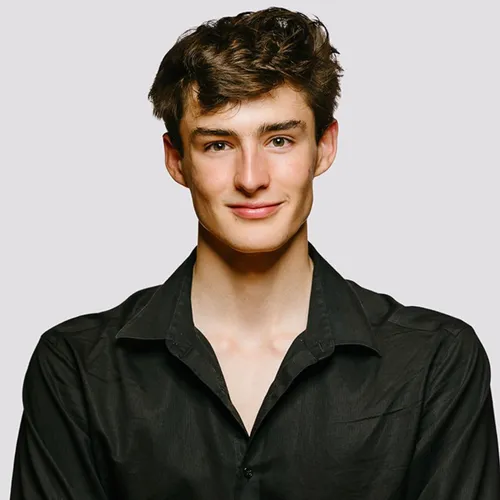
Liam CUMMINS (born in 2004, in the United States) writes music that builds bridges, bringing wide-ranging ideas and people together. His compositions span the extremes of grand gesture and subtle nuance, vibrant lyricism and bitter dissonance, high drama and piercing simplicity. Knitting together diverse materials and sound-worlds, he seeks new windows into age-old traditions.
His music has been widely recognized for its incisive craft and emotional sensitivity. He has received recent commissions from Orchestra of St. Luke's, New York Youth Symphony, Orchestra Lumos, The Juilliard School's AXIOM, and Aspen Contemporary Ensemble, among other orchestras, ensembles and soloists across the United States and internationally. He is a recipient of a 2024 Charles Ives Scholarship from the American Academy of Arts and Letters, a 2023 ASCAP Morton Gould Award, and the 2022 YoungArts Gold award in Classical Music. His music has also been recognized by Tribeca New Music, Orchestra of St. Luke's, New York Youth Symphony, American Composers Orchestra, National Young Composers Challenge, The Silent Voices Project, Juilliard's AXIOM competition, the New England Philharmonic, Icarus Quartet and NPR's The American Sound. In 2022, he was the only young composer in the country nominated for consideration as a United States Presidential Scholar in the Arts. His music has premiered at Alice Tully Hall, The Kennedy Center for the Performing Arts, Aspen Music Festival, Carnegie Hall's Stern Auditorium and numerous other venues throughout around the world.
Liam is pursuing a Bachelor of Music degree in composition at The Juilliard School, studying with John Corigliano. He has been awarded fellowships at Aspen Music Festival, National YoungArts Week and the DeGaetano Composition Institute, and has participated in festivals including Curtis Institute of Music’s Young Artist Summer Program, Yellow Barn's Young Artist Program, The Walden School, the Cleveland Institute of Music's Young Composers Program. Through these opportunities he has studied with luminaries including Augusta Read Thomas, Christopher Theofanidis, Kevin Puts, David Ludwig, Pierre Jalbert, Reiko Füting, Melinda Wagner, George Tsontakis, Zhou Long, Nico Muhly, Ana Sokolovic, Eric Nathan, Pascal Le Boeuf and Chen Yi.
Liam is an avid backpacker and adventurer. When not making music, you’ll likely find him in the natural world, camera and notebook in hand, seeking adventure at every opportunity. In turn, these experiences deepen and enrich his musical passion.
More information available at LiamCummins.com.
This piece’s original title was “A Gentle Plea for Chaos.” This title came from, of all places, a book about English Gardening. I loved its mysteriousness and intrigue. As I wrote, I realized that this piece wasn’t exactly a plea for chaos, in any obvious sense. Thus, the title became A Gentle Plea. Then I realized (after writing one particularly bombastic section) that the piece was in no way gentle. The title became simply “Plea.”
We all have our pleas – personal and universal, reasonable and impossible, large and small. Maybe they are pleas to our friends, families, lovers, maybe to god or to ourselves, maybe whispered into the world for anyone (or no one) to hear. In this piece, the violin is constantly pleading, with the orchestra and with itself. No matter how desperate or heartfelt, its pleas are never answered, so it laments time and time again with a mournful passage.
In this piece, pleading is symbolized by a descending half-step gesture. It is first announced by a "water crotale" peal, in which the chiming instrument is dipped in a bowl of water to manipulate its pitch by a semitone. Throughout the piece, this simple descending gesture is imbued in the fabric of the piece on every level. Whether frantic or lamenting, toccata-like or texture-based, the music evokes a quality of pleading in its own way. Never does it quite attain what it desires.
Liam CUMMINS