
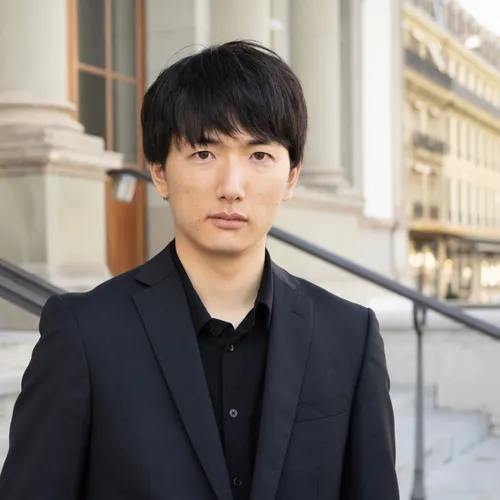
Born in Japan in 1995, Yuki NAKAHASHI studied composition with Ichiro Nodaira at the Tokyo University of the Arts, earning a master's degree in composition. Since 2020 he has continued his studies at the Conservatoire de Paris with Stefano Gervasoni, Yan Maresz, Luis Naon, and Gregoire Lorieux, receiving a master's diploma in 2025. He is currently pursuing a PhD at the Graduate School of Tokyo University of the Arts under the supervision of Toshiyuki Orikasa.
He often draws inspiration from outdoor soundscapes, attentive to their complexity and subtlety.
Ideas gathered through fieldwork inform his development of vocal technique and harmonic language as he explores how musical organicity can be realized.
This practice is sometimes tied to computer-assisted composition using OpenMusic and Max/MSP, through which he studies methods for translating objective acoustic phenomena into polysemic, personal musical contexts.
He is currently conducting doctoral research on compositional methodologies for hybrid instruments. This research aims to systematize and articulate approaches to integrating instrumental performance and electroacoustic sound through hybrid instruments, presenting them as compositional methodologies specific to this medium.
His work has been recognized in many competitions in Japan and abroad. At the 2022 Geneva International Competition, he was awarded Second Prize, as well as the Young Audience Prize, the Student Prize, and the Nicati-de Luze Prize. In 2025, he received the Jury Prize at the Quatuor Lontano Call. In 2024, his Fanfare for the 10th Anniversary of the Radio France Auditorium was performed by the Orchestre National de France. His graduation composition at the Conservatoire de Paris, And I sole ear for 21 musicians and electronics, was nominated for the 36th Yasushi Akutagawa Suntory Award for Music Composition. He is also a recipient of the 43rd Toyama Award.
His music has been performed by ensembles including Ensemble Intercontemporain, the Berg Orchestra, Neue Vocalsolisten Stuttgart, and the Tokyo Geidai Philharmonia.
He has received support from the Agency for Cultural Affairs (Japan), the Rohm Music Foundation, and the Kakehashi Foundation
Cette œuvre explore les relations possibles entre le saxophone et le piano, deux instruments de natures fondamentalement distinctes. Plutôt que de chercher à les fusionner, la pièce assume et accentue leurs disparités d'intervalles et de gestique, engendrant ainsi des ruptures dans le discours musical.
Le premier mouvement repose sur le principe de la variation. Dès l'ouverture, un motif descendant en doubles croches est exposé - de manière chromatique au piano, par des intervalles microtonaux au saxophone. Ce décalage ludique réapparaît sous différentes formes à chaque retour du motif.
Par ailleurs, le piano ne se contente pas d'accompagner le saxophone ; il introduit parfois des gestes qui contrastent avec ceux du saxophone, et provoquent ainsi la dissolution de la coordination entre les deux instruments.
En revanche, le deuxième mouvement s'articule autour de la présentation d'harmonies déployées dans la durée. Il a pour axe central l'exploration de couleurs harmoniques et de leur transformation progressive.
Ces transformations s'opèrent grâce à une grande variété de trilles multi-phoniques et bi-chromatiques, par alternances entre deux échelles chromatiques distinctes, fondée sur le demi-ton pour l’une et sur le micro-intervalle, pour l’autre - ainsi qu'à une construction harmonique basée sur le cycle des quintes.
Cependant, le motif descendant qui caractérise le premier mouvement demeure latent tout au long du second. Il émerge explicitement à la fin de l'œuvre, là où la différence irréductible entre les deux instruments se manifeste finalement comme une différence de temporalité.
Yuki Nakahashi
30/06/2026