
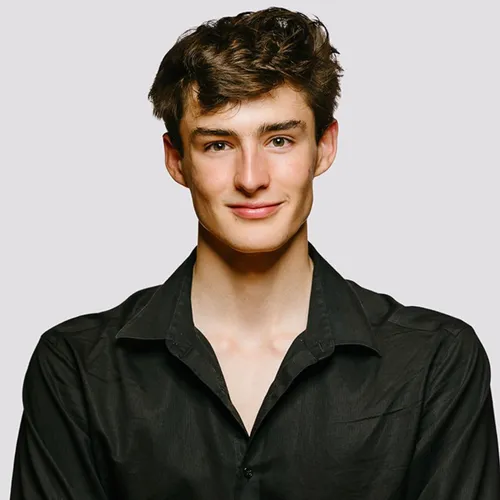
Liam CUMMINS (born in 2004, in the United States) writes music that builds bridges, bringing wide-ranging ideas and people together. His compositions span the extremes of grand gesture and subtle nuance, vibrant lyricism and bitter dissonance, high drama and piercing simplicity. Knitting together diverse materials and sound-worlds, he seeks new windows into age-old traditions.
His music has been widely recognized for its incisive craft and emotional sensitivity. He has received recent commissions from Orchestra of St. Luke's, New York Youth Symphony, Orchestra Lumos, The Juilliard School's AXIOM, and Aspen Contemporary Ensemble, among other orchestras, ensembles and soloists across the United States and internationally. He is a recipient of a 2024 Charles Ives Scholarship from the American Academy of Arts and Letters, a 2023 ASCAP Morton Gould Award, and the 2022 YoungArts Gold award in Classical Music. His music has also been recognized by Tribeca New Music, Orchestra of St. Luke's, New York Youth Symphony, American Composers Orchestra, National Young Composers Challenge, The Silent Voices Project, Juilliard's AXIOM competition, the New England Philharmonic, Icarus Quartet and NPR's The American Sound. In 2022, he was the only young composer in the country nominated for consideration as a United States Presidential Scholar in the Arts. His music has premiered at Alice Tully Hall, The Kennedy Center for the Performing Arts, Aspen Music Festival, Carnegie Hall's Stern Auditorium and numerous other venues throughout around the world.
Liam is pursuing a Bachelor of Music degree in composition at The Juilliard School, studying with John Corigliano. He has been awarded fellowships at Aspen Music Festival, National YoungArts Week and the DeGaetano Composition Institute, and has participated in festivals including Curtis Institute of Music’s Young Artist Summer Program, Yellow Barn's Young Artist Program, The Walden School, the Cleveland Institute of Music's Young Composers Program. Through these opportunities he has studied with luminaries including Augusta Read Thomas, Christopher Theofanidis, Kevin Puts, David Ludwig, Pierre Jalbert, Reiko Füting, Melinda Wagner, George Tsontakis, Zhou Long, Nico Muhly, Ana Sokolovic, Eric Nathan, Pascal Le Boeuf and Chen Yi.
Liam is an avid backpacker and adventurer. When not making music, you’ll likely find him in the natural world, camera and notebook in hand, seeking adventure at every opportunity. In turn, these experiences deepen and enrich his musical passion.
More information available at LiamCummins.com.
Le titre initial de cette pièce était A Gentle Plea for Chaos (Un doux appel au chaos).
Ce titre m’est venu, contre toute attente, d’un livre sur l’art des jardins anglais. J’aimais son côté mystérieux et intrigant.
Au fur et à mesure que j’écrivais, je me suis rendu compte que ce texte n’était pas vraiment un plaidoyer pour le chaos, au sens strict du terme. Le titre est donc devenu
A Gentle Plea (Un doux plaidoyer).
Puis je me suis rendu compte (après avoir écrit une partie particulièrement grandiloquente) que le texte n’avait rien de doux. Le titre est alors devenu simplement Plea (Plaidoyer).
Nous avons tous nos propres prières – personnelles ou universelles, raisonnables ou impossibles, grandes ou petites. Peut-être s’adressent-elles à nos amis, à notre famille, à nos amours, peut-être à Dieu ou à nous-mêmes, peut-être murmurées au monde pour que n’importe qui (ou personne) ne les entende.
Dans cette pièce, le violon ne cesse de supplier, tantôt l’orchestre, tantôt lui-même. Aussi désespérées ou sincères soient-elles, ses supplications restent sans réponse, et il se lamente donc encore et encore dans un passage mélancolique.
Dans cette pièce, l’imploration est symbolisée par un motif descendant d’un demi-ton. Elle est d’abord annoncée par un son de crotales « à l’eau », technique consistant à plonger cet instrument dans un bol d’eau pour modifier sa hauteur d’un demi-ton. Tout au long de la pièce, ce simple motif descendant imprègne la texture de l’œuvre à tous les niveaux.
Qu'elle soit frénétique ou plaintive, de type toccata ou axée sur la texture, la musique évoque à sa manière une forme de supplication. Jamais elle n’atteint tout à fait ce qu'elle désire.
Liam CUMMINS
Traduit de l’anglais