
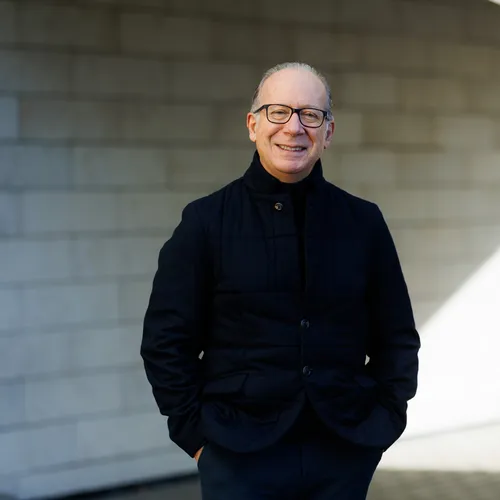
Ivan FEDELE (born in Lecce - Italy, in 1953), is regarded as one of the most important contemporary composers.
His catalogue comprises around 200 works and includes compositions both with and without electronics, for chamber and symphonic ensembles (notably the Syntax and Lexikon cycles), for music theatre (Antigone from Sophocles, Thanathoséros from Tasso, and Words and Music by Beckett), for radio (Pentalogon, Barbara mitica and Orfeo al cinema Orfeo on texts by G. Corti), as well as for silent film (La Chute de la maison Usher by J. Epstein). His recent works also include the video opera Galileo’s Journey.
His music has been conducted by, among others, Pierre Boulez, Christoph Eschenbach, Myung-whun Chung, Riccardo Muti, Leonard Slatkin, Antonio Pappano, Riccardo Chailly, Esa-Pekka Salonen, David Robertson, John Axelrod and Dmitri Liss, and performed by leading orchestras and ensembles such as the BBC Symphony Orchestra, RIAS Berlin, the Chicago Symphony Orchestra, the San Francisco Symphony, the SWR Stuttgart, the Orchestre National de France, the Orchestre National de Lyon, the Warsaw Symphony Orchestra, the RAI National Symphony Orchestra, the Orchestra dell’Accademia Nazionale di Santa Cecilia, the Tokyo Metropolitan Symphony Orchestra, the Seoul Philharmonic Orchestra, the Ural Philharmonic Orchestra, Ensemble InterContemporain, the London Sinfonietta and Klangforum Wien.
Ivan Fedele’s idea of music can be summed up in the expression “sculpting the sound”, a programmatic intention realised through the conception and evolution of musical material and its forms by means of a figural grammar (especially from his early period up to the beginning of the new millennium) and, subsequently, according to a generative grammar in which it is the sound itself that “tells” its story.
At the core of his compositional thinking lies the perceptive dimension of the work, and all strategies that shape the imagination are modulated accordingly.
The influence of Pierre Boulez and Luciano Berio was decisive for Fedele’s artistic development, as was his encounter with Franco Donatoni during the 1980s.
Ivan Fedele was Professor at the Accademia Nazionale di Santa Cecilia until 2023 and served as Artistic Director of the Music Sector of the Venice Biennale from 2012 to 2020.
Among the various distinctions awarded to him are the honour of Chevalier de l’Ordre des Lettres et des Arts conferred by the French Ministry of Culture (2000), the lifetime achievement award A. Honegger (2016), and the honour of Chevalier de l’Ordre du Mérite Culturel (2021) bestowed by Prince Albert II of Monaco.
The music of Ivan Fedele is published by SZ Sugar.
LouLa Sonnets is a composition for cello and female choir set to texts by the Lyonnese poet Louise Labé (c. 1524–1566), the foremost representative of the French Renaissance. Five hundred years after her birth, "la belle cordière" (as she was nicknamed due to the rope- making profession of both her father and her husband) appears to us as a woman of immense contemporary relevance, from both a poetic and a social standpoint. A champion of culture and women's empowerment, she promoted a circle of artists and intellectuals—a salon that became the subject of gossip regarding her allegedly licentious life. In reality, very little is known about her life, and what has reached us is always second- or third-hand. This has contributed to an aura of mystery around her persona, even leading some to question her very existence by attributing her poems to male poets of the Lyonnese School gatheredaround their leader Maurice Scève—a hypothesis rejected by historians. Following in the footsteps of Vittoria Colonna and Gaspara Stampa, Louise Labé rejects the stereotypes of the woman-as-object and the woman-as-angel, becoming the firsthand protagonist of her own romantic and social experiences. One of the poetic themes characterizing her art is the dream, understood as an erotic fantasy contrasting with the chaste Petrarchan world. In her poetry, we find neither the presence of God nor, much less, any signs of conversion. The musical composition is divided into three parts, each utilizing a sonnet by "la belle cordière": “Claire Vénus” (Sonnet V), “Je vis, je meurs!..” (Sonnet VIII), and “Ô beaux yeux bruns” (Sonnet II). The cello plays a central role in the composition as the alter ego of the lute (an instrument frequently evoked by the poet), which, in Louise Labé’s Sonnets, takes on a deeply sensual significance as a catalyst for emotions and erotic allusions. The vocal writing, entrusted to a choir of female voices, alternates moments of lyrical intensity with moments of vocal transfiguration. This is enhanced by a highly varied Sprechgesang that shatters and recombines into a kaleidoscope of timbral solutions, matching the shifting emotions evoked by the text.